
How to Calculate Cooling Tower Fill Volu
In modern industrial cooling systems, co
When the Original Cooling Tower Fill Is
Replacing old Cooling Tower Fill should improve heat transfer, but a new fill does not automatically solve every cooling problem. If water distribution, airflow, installation, or operating conditions are limiting the tower, the new Cooling Tower Media may still underperform.
For retrofit projects, the right approach is to identify the actual performance limitation first, then select fill according to tower type, dimensions, water quality, and required cooling duty.
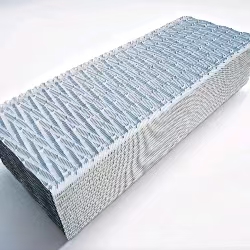
Cooling Tower Fill increases the contact area between air and water. Film-type fill spreads circulating water into thin films across formed sheets, allowing evaporation to remove heat as air passes through the fill.
Actual performance depends on four factors working together:
A fill with good thermal characteristics cannot compensate for inadequate water flow or restricted airflow.
Uneven water distribution is one of the first conditions engineers should check. Dry areas reduce the effective heat transfer surface, while excessive water loading in other areas can increase pressure drop and reduce operating efficiency.
Before blaming the fill, check:
If the distribution system is not delivering water evenly, replacing the fill alone is unlikely to produce the expected cooling improvement.
Cooling performance depends on the interaction between water and air. Fan problems, blocked air passages, excessive fill pressure drop, or damaged tower components can limit airflow through the fill.
This is particularly important during replacement projects because the new fill geometry must be compatible with the existing fan and airflow system.
In a counterflow tower, air moves upward while water moves downward. The fill must maintain stable channels for countercurrent air-water contact without creating excessive airflow resistance.
For this reason, engineers should select the fill according to the tower's thermal and hydraulic requirements rather than simply copying the dimensions of the old product.
Crossflow towers introduce air horizontally through the fill while water moves vertically. Replacement fill therefore needs to match the available width, height, pitch, airflow path, and water distribution arrangement.
For retrofit projects requiring a range of standard widths, Multi-Specification Cross Flow Cooling Tower Fill can simplify replacement planning when different tower sections require different fill dimensions.
Film Fill provides high heat transfer efficiency by maintaining a large wetted surface area in a compact volume. It is generally suitable when circulating water is adequately treated and suspended solids are controlled.
However, narrow flow channels can become restricted by scale, biological growth, or suspended solids. Fill selection should therefore consider water quality as carefully as thermal performance.
Some industrial cooling systems operate with wastewater, recycled process water, or higher suspended-solid loading. In these conditions, an open splash structure can provide better resistance to blockage than closely spaced film sheets.
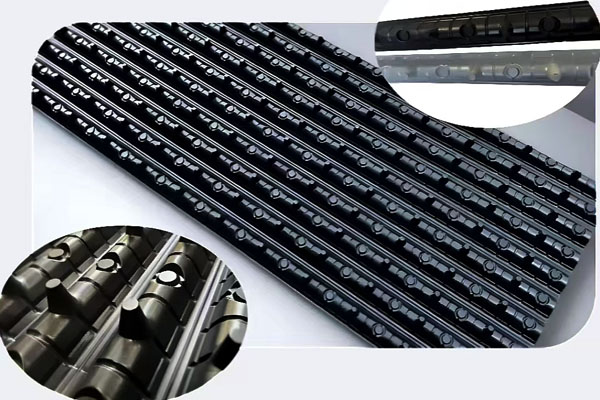
For these applications, Splash Grid Fill for Fouling-Prone Cooling Towers can be considered when maintaining open passages and reducing fouling risk is more important than achieving the highest possible fill density.
A common retrofit mistake is treating fill dimensions as a simple measurement exercise. The replacement must physically fit, but dimensions also influence airflow distribution, water loading, fill volume, and installation stability.
Engineers should confirm:
For towers requiring a defined crossflow block size, 1010mm-2500mm Cross Flow Cooling Tower Fill provides a specific dimensional option for replacement and retrofit applications.
Correct product selection is only part of the retrofit. Installation must preserve the designed airflow and water path.
Some formed fill designs have a defined air and water flow direction. Incorrect orientation can change pressure drop and reduce effective heat transfer.
Large gaps between fill blocks can create bypass airflow. Air then moves around the fill instead of passing through the intended heat transfer surface.
Fill blocks must remain properly supported during continuous operation. Movement, compression, or deformation can change the designed flow channels and reduce long-term performance.
Before purchasing new Cooling Tower Media, collect actual operating data rather than relying only on the original fill specification.
This information allows the manufacturer to determine whether the existing fill should be replaced with the same configuration or whether a different fill geometry is more appropriate.
Maximum thermal efficiency is not always the correct retrofit target. A highly compact film structure may deliver strong heat transfer under clean-water conditions but become difficult to maintain when the circulating water contains significant solids or biological contamination.
For a reliable retrofit, engineers should balance thermal performance with fouling resistance, airflow requirements, water quality, maintenance capability, and expected service life.
New fill still requires proper operating control. Poor water treatment or uneven distribution can shorten its service life regardless of the initial product quality.
A cooling tower fill replacement should start with diagnosis, not with a product catalogue. If the real problem is water distribution, airflow, fouling, or incorrect installation, installing a new fill without correcting the cause will only repeat the same performance problem.
The reliable approach is to match the Cooling Tower Fill to the tower design, operating conditions, water quality, and available installation space. This is how a retrofit becomes a performance improvement rather than simply a component replacement.
New Cooling Tower Fill can restore cooling performance, but only when the fill is correctly matched to the system and installed under suitable operating conditions.
For retrofit projects, the key is not choosing the most expensive or highest-efficiency product. It is choosing the right fill geometry for the tower, the right structure for the water condition, and the right dimensions for the existing installation.
Cooling tower fill media updates and technical insights for global industrial clients.
In modern industrial cooling systems, cooling tower fill plays a critical role in improving heat exc
Why Is My Reconditioned Cooling Tower Underperforming After Installation? Check These Before Replaci
Contact our team for cooling tower fill media details, quotations, and project support.
Chat on WhatsApp