
How to Calculate Cooling Tower Fill Volu
In modern industrial cooling systems, co
When the Original Cooling Tower Fill Is
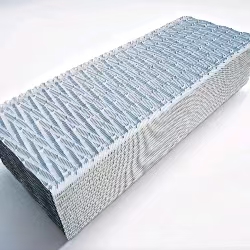
A finished honeycomb cooling tower fill block looks relatively simple when it is installed inside a tower.
For a buyer, it can be tempting to think of it as plastic sheet cut into shape and assembled into a block.
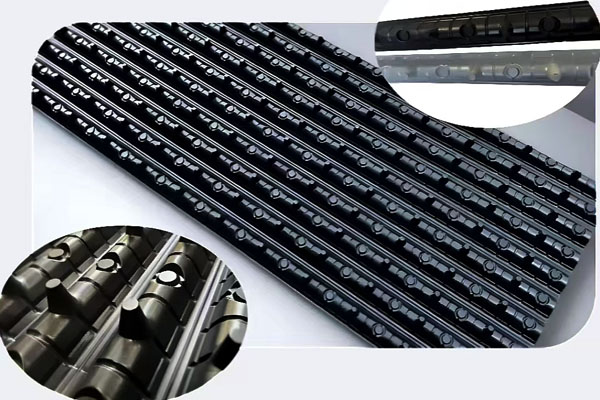
In a cooling tower fill factory, however, the finished structure depends on several production stages. The geometry visible in the final cooling tower packing is the result of material preparation, forming, feeding and subsequent assembly rather than one single operation.
The final honeycomb structure starts with a plastic material that needs to be processed into a suitable sheet.
For cooling tower applications, the manufacturing process needs to maintain a consistent sheet condition because variations in the sheet can later become variations in the formed structure.
This is one reason manufacturing discussions about international cooling tower fill are not only about packaging and export. The physical consistency of the product has to survive the entire production process before the material ever reaches the tower.
One of the less visible parts of plastic sheet production is the feeding process associated with the calendering system.
The keyword compounding system calender feeding may sound more relevant to plastic processing than to cooling tower engineering, but it represents an important connection between raw material processing and the sheet that eventually becomes Cooling Tower Media.
If the upstream material preparation and feeding conditions are unstable, downstream forming cannot magically remove every variation.
Once the sheet is ready, it can be formed into the required corrugated or structured pattern.
This is the stage where the geometry that engineers later discuss as pitch, passage and sheet pattern begins to become a physical product.
For example, 18mm Pitch Corrugated Fill with a Wide Selection of Available Widths represents a configuration in which the internal pattern and the available section widths are both part of the product specification.
Not every cooling tower uses a large fill section.
Some installations require relatively compact sections because of the tower structure, replacement access or the way the internal area is divided.
Compact 19mm Pitch Cooling Tower Fill in 305mm and 610mm Widths is a good example of why a cooling tower fill factory needs more than one physical configuration to serve actual tower layouts.
After the formed sheets are prepared, they need to become the final fill configuration used by the customer.
The assembly method therefore becomes another practical manufacturing consideration.
For projects where installation conditions differ, Cooling Tower Fill with Dual Connection Options provides an example of how the final product can be prepared with different installation requirements in mind.
A more specific configuration is available in 870mm Cooling Tower Media with 16mm Pitch and Dual Connection Options.
A factory's capability is not demonstrated only by saying that it can produce Cooling Tower Fill.
It becomes more visible when the manufacturer can handle different widths, different pitches, different tower layouts and different installation requirements without turning every project into a completely new manufacturing problem.
The range represented by 1470mm Width Cross-flow Fill, SteadyFlow 1000-1250 Cross-flow Fill shows why dimensional flexibility matters when serving different tower configurations.
For some projects, the requirement may be a specific wide section. For others, several widths may need to be combined.
A cooling tower fill factory should not treat manufacturing and installation as completely separate subjects.
The final product has to leave the factory in a condition that makes sense for the actual tower where it will be installed.
That is particularly important for replacement projects, where the tower already exists and the manufacturer has to work around dimensions and structural limitations that cannot easily be changed.
Good packing cooling tower production is therefore not just about producing plastic sheets quickly. It is about maintaining the geometry and physical consistency required for the finished fill to perform as intended after installation.
Cooling tower fill media updates and technical insights for global industrial clients.
In modern industrial cooling systems, cooling tower fill plays a critical role in improving heat exc
Why Is My Reconditioned Cooling Tower Underperforming After Installation? Check These Before Replaci
Contact our team for cooling tower fill media details, quotations, and project support.
Chat on WhatsApp