
How to Calculate Cooling Tower Fill Volu
In modern industrial cooling systems, co
When the Original Cooling Tower Fill Is
One thing I always pay attention to when inspecting honeycomb cooling tower fill is whether the water is actually using the available media surface.
A fill pack may look perfectly normal from the outside. The sheets are in place, the channels are open, and nothing appears seriously damaged.
But once the tower starts operating, you may notice that some areas carry considerably more water than others.
That is worth investigating because the cooling performance depends on how effectively the circulating water is distributed across the available fill surface.
When water concentrates in one part of a honeycomb fill pack, I usually check the distribution system before blaming the media.
In counterflow towers, blocked spray nozzles or uneven spray coverage can leave some sections receiving much less water than intended.
In crossflow towers, the condition of the gravity distribution basin and its openings can produce similar problems.
If the incoming water is already uneven, the fill cannot always correct that distribution by itself.
This is particularly important with structured media, where the arrangement of the channels influences how water travels through the pack.
The corrugated sheets inside honeycomb cooling tower media create passages for water and air.
Depending on the geometry, the surface pattern can encourage water spreading and redistribution.
However, the amount of redistribution varies between designs.
A fill pack cannot be expected to compensate for a severely unbalanced distribution system.
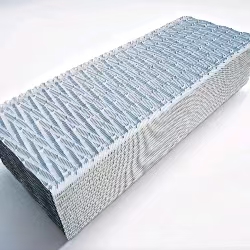
For example, multi-width honeycomb cooling tower fill for different tower configurations provides options for matching the media arrangement to different tower layouts.
But even when the dimensions fit correctly, the water distribution above the fill still needs to be checked.
During an inspection, I would compare the condition of neighboring fill sections.
If one area is consistently wet while another receives little water, the next step is to investigate the distribution pattern.
Uneven mineral deposits can also provide clues.
Heavy deposits in one location may indicate repeated concentration of water flow, although local water chemistry and airflow conditions must also be considered.
Do not assume that every dry-looking section is caused by defective fill.
Sometimes the water distribution system is functioning reasonably well, but the installed fill geometry is not suitable for the operating conditions.
Different corrugation structures can produce different water spreading characteristics.
A design such as double-wave cross-flow cooling tower fill is worth examining when comparing alternative surface geometries for a crossflow application.
That does not mean a double-wave structure automatically solves uneven water distribution.
The water loading, airflow conditions, and complete sheet geometry must be considered together.
If the media remains structurally sound and the main problem comes from the distribution system, replacing the fill may achieve very little.
However, replacement may be necessary when the channels have become permanently deformed, heavily blocked, or mechanically damaged.
Before selecting new media, compare the original channel structure with the proposed replacement.
For towers requiring different sheet widths, multi-width cooling tower fill for flexible installation may provide a useful dimensional reference.
If water appears to be using only part of a honeycomb cooling tower fill pack, start with the water distribution system.
Then inspect the channel condition, sheet arrangement, and support structure.
A replacement decision becomes much easier once you know whether the problem comes from uneven water supply, damaged media, or unsuitable channel geometry.
If you're discussing a replacement with a manufacturer, photographs showing the wet and dry sections are often more useful than a general description of poor cooling performance.
Cooling tower fill media updates and technical insights for global industrial clients.
In modern industrial cooling systems, cooling tower fill plays a critical role in improving heat exc
Why Is My Reconditioned Cooling Tower Underperforming After Installation? Check These Before Replaci
Contact our team for cooling tower fill media details, quotations, and project support.
Chat on WhatsApp