
How to Calculate Cooling Tower Fill Volu
In modern industrial cooling systems, co
When the Original Cooling Tower Fill Is
When a cooling tower starts delivering warmer outlet water, many maintenance teams immediately look for obvious damage. They check the fan, inspect the pump, look at the nozzles and, eventually, open the tower to see whether the Cooling Tower Fill is broken.
But here is something that is easy to miss: cooling tower fill does not have to look damaged to lose a significant part of its working performance.
A film fill cooling tower can continue running with fill sheets that look perfectly normal from the outside while the actual heat transfer area is being reduced by scaling, uneven wetting, biological growth, blocked air passages or water distribution problems.
This is one of the reasons why replacing Cooling Tower Media should not be treated as simply removing the old blocks and installing new ones. Before choosing new tower fill, it is worth understanding what actually caused the performance loss.
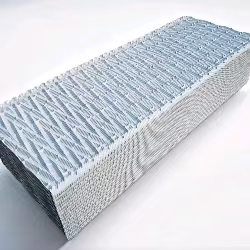
Cooling tower fill is the working surface where water and air come into close contact. Depending on the design, water can either form a thin film over corrugated sheets or repeatedly break into droplets across a splash-type structure.
In a film fill cooling tower, the objective is to create a large effective surface area while keeping the water distributed across the fill structure. The corrugations help guide water downward and promote contact between the falling water and moving air.
This is why the terms Cooling Tower Fill, Cooling Tower Media, Film Fill, Cooling Fill and tower fill are often used by engineers and purchasing teams when discussing the same general component.
The important word here is effective.
A fill block may have a large theoretical surface area, but if only part of that surface is properly wetted or if the air cannot move through the channels, the real operating performance will be much lower than expected.
One of the most underestimated problems is not the fill itself but the way water reaches it.
If one area of the fill receives too much water while another area receives too little, the tower is not using its entire heat transfer surface effectively. Some channels become heavily loaded while other areas remain partially dry.
This can happen because of blocked nozzles, worn spray devices, incorrect water pressure, damaged distribution pipes or changes in operating flow.
In a counterflow system, poor spray distribution can be particularly important because the water needs to be distributed across the upper section of the fill before travelling downward against the upward airflow.
In a crossflow system, the distribution basin and water outlets have their own influence on how evenly the Crossflow Film Fill is wetted.
If you are investigating poor cooling performance, do not inspect only the bottom of the fill. Look at the complete water distribution pattern.
Scaling is more than a cosmetic problem.
Mineral deposits can gradually build up on the surface of Cooling Tower Fill. As deposits become thicker, the original channel geometry becomes smaller and less predictable.
That creates two problems at the same time.
First, the available heat transfer surface changes. Second, the resistance to airflow and water flow can increase.
This is particularly important for corrugated film fill because the small passages that create a large contact area are also the passages most vulnerable to blockage.
A tower can therefore experience declining performance long before an operator sees a completely collapsed or broken fill pack.
Cooling tower water is an environment where biological growth can become a practical maintenance issue.
Slime, algae and biological deposits can accumulate on Cooling Tower Media and inside water passages. Depending on the operating conditions, the material may initially appear as a thin surface layer rather than an obvious blockage.
However, repeated accumulation can reduce open area and change water distribution.
This is why water treatment and fill maintenance should not be considered two completely separate subjects. The life of Film Fill is closely connected to the quality and treatment of the circulating water.
Cooling tower performance depends on both sides of the heat exchange process.
Water needs to reach the fill correctly, but air also needs a relatively unobstructed path through it.
If air inlet louvers are damaged, partially blocked or poorly aligned, the tower may not receive the airflow required by the original design.
Likewise, excessive fouling inside the fill can increase airflow resistance.
This is why replacing tower fill without checking the surrounding air path can sometimes produce disappointing results.
Counterflow towers move air upward while water moves downward.
This arrangement makes the interaction between water distribution, fill geometry and airflow particularly important.
For replacement projects, the fill height, block dimensions, flute geometry, support arrangement and water distribution pattern should all be considered together.
A suitable Counterflow Film Fill can provide a large effective contact area, but only when the tower's hydraulic and airflow conditions match the fill design.
In a crossflow tower, air generally travels horizontally through the fill while water moves downward.
This means the relationship between the water distribution basin, fill depth and air entry area becomes especially important.
For replacement work, a 1010mm-2500mm Cross Flow Cooling Tower Fill should be selected according to the original tower structure rather than simply according to the nominal dimensions of the old fill.
This is one of the questions I would be careful with when discussing a retrofit.
Adding more fill height or selecting a fill with a higher theoretical surface area does not automatically mean the tower will perform better.
The tower still has limits in airflow, water loading, fan capacity, distribution quality and available space.
If the new fill creates too much air resistance, the fan may not be able to move the required volume of air.
If the water distribution system cannot wet the additional fill evenly, part of the added surface area may provide little practical benefit.
So instead of asking only, “How much surface area does this fill have?”, ask:
PVC is widely used for film fill applications because it can provide a practical balance between cost, formability and operating performance.
However, the actual suitability of PVC depends on operating temperature, chemical exposure, UV exposure and water quality.
For many conventional industrial and HVAC applications, PVC cooling tower fill can be a practical choice when the operating conditions are within the material's working range.
Polypropylene is another important option, particularly when the project requires different temperature or chemical resistance characteristics.
A PP Cooling Tower Fill should be evaluated based on actual operating conditions rather than simply assuming PP is always better than PVC.
Material selection should consider circulating water temperature, chemical exposure, cleaning methods, sunlight exposure and expected service life.
Before ordering replacement Cooling Fill, I normally recommend checking the tower in this order:
This sequence is useful because it prevents the common mistake of blaming the fill for every cooling problem.
The fill does not work independently.
Air entering through damaged or heavily fouled louvers can disturb the airflow distribution. At the other end of the tower, poorly performing drift eliminators can increase water carryover and pressure loss.
For this reason, a fill replacement project can be a good opportunity to inspect the entire internal airflow path.
Products such as Cooling Tower Air Inlet Louvers and Drift Eliminators should be evaluated when the tower has been operating for many years.
If a customer asks me for a quick quotation, I would not want only the tower width and length.
I would also ask for:
These details make the quotation much more meaningful.
Good maintenance does not mean constantly removing the fill.
It means controlling the conditions that cause the fill to deteriorate.
If a cooling tower is losing performance, do not assume that the fill must be physically broken before it needs attention.
Cooling Tower Fill can lose effective performance because of scaling, biological growth, poor water distribution, airflow restriction and gradual deformation. The most reliable approach is to look at the tower as a complete air-water system.
When replacement is necessary, select the fill according to tower type, water quality, operating temperature, airflow and physical dimensions. For towers operating under heavy fouling conditions, Splash Grid Fill for Fouling-Prone Cooling Towers may also be worth evaluating where an open splash structure is more appropriate.
That approach normally produces a better result than simply buying the cheapest tower fill with the highest advertised surface area.
Cooling tower fill media updates and technical insights for global industrial clients.
In modern industrial cooling systems, cooling tower fill plays a critical role in improving heat exc
Why Is My Reconditioned Cooling Tower Underperforming After Installation? Check These Before Replaci
Contact our team for cooling tower fill media details, quotations, and project support.
Chat on WhatsApp