
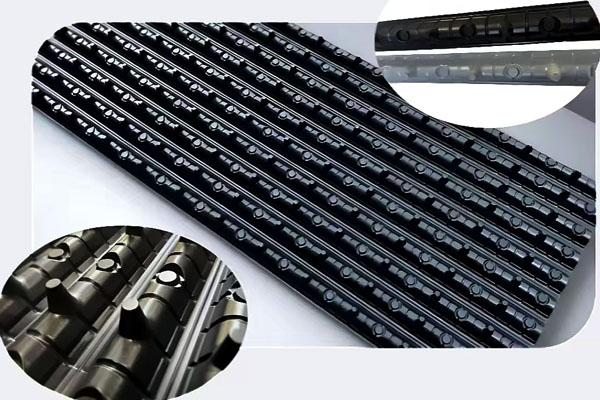
In modern industrial cooling systems, co
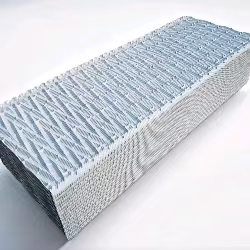
How to Calculate Cooling Tower Fill Volu
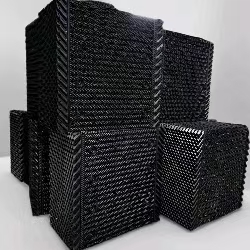
When the Original Cooling Tower Fill Is
Biofilm is a common cause of Cooling Tower Fill performance loss. A tower may still be running normally while biological deposits gradually reduce heat transfer, restrict airflow, and increase cleaning frequency.
Film Fill provides a large wetted surface for efficient air-water contact. That same surface can also collect biological deposits when water treatment, sunlight exposure, and operating conditions are not properly controlled.
For cooling tower operators, the key is not simply removing biofilm after it appears. The better approach is to understand why it forms and select Cooling Tower Media that matches the actual operating conditions.
Biofilm is a layer of microorganisms attached to a wet surface. In cooling towers, bacteria, algae, organic matter, and minerals can combine to form deposits on the fill.
The main conditions that encourage biological growth include:
Once deposits build up, the problem becomes more than a cleanliness issue. The deposits can change water distribution and restrict the designed airflow paths through the Cooling Tower Fill.
Film Fill works by spreading water across a large surface area while air moves through the fill channels. This provides efficient heat transfer without requiring a large fill volume.
However, biological deposits can cover the wetted surface and partially block the air passages. As fouling increases, the effective heat transfer area decreases and airflow resistance can increase.
Common operating symptoms include:
This is why a cooling tower should be evaluated as a complete system rather than assuming that the fill itself is the only cause of poor performance.
The most effective way to control biofilm is to maintain the circulating water within the required treatment limits.
Operators should regularly monitor:
Water treatment should be based on the actual system and local operating requirements. Simply increasing chemical dosing is not a substitute for proper monitoring and control.
Outdoor cooling towers can receive significant sunlight, particularly around open fill areas and water distribution sections. Light can encourage algae growth when nutrients and moisture are available.
Stagnant or poorly distributed water creates another problem. Areas that remain continuously wet but receive insufficient flow can become localized fouling zones.
For this reason, water distribution should be inspected whenever abnormal fouling appears. Replacing the fill without correcting the distribution problem may only reproduce the same failure.
Film Fill generally provides higher heat transfer efficiency and a more compact design, but it requires suitable water quality and regular fouling control.
Where suspended solids, biological contamination, or other fouling risks are consistently high, engineers may instead evaluate splash-type Cooling Tower Media with a more open structure.
The correct choice depends on the balance between thermal performance, water quality, cleaning requirements, and available tower volume. There is no single fill structure that is optimal for every cooling tower.
Fill geometry determines how water spreads and how air passes through the tower. Sheet spacing, corrugation, channel geometry, and block arrangement all affect the tendency of deposits to restrict flow.
For crossflow cooling towers, the fill must also match the horizontal airflow path and the existing water distribution arrangement. A suitable Dual-spec High-efficiency Cross-flow Fill can be considered when a crossflow retrofit requires a fill design that balances thermal performance with the existing tower configuration.
The important point is that higher thermal performance should not be considered separately from water quality. A high-efficiency fill still requires operating conditions that keep its channels open and its surface properly wetted.
When existing fill is heavily contaminated, deformed, or permanently damaged, cleaning may no longer restore the required performance. Before replacement, engineers should identify why the original fill deteriorated.
The evaluation should include:
For crossflow replacement projects, 16.5 Multi-width Cross-flow Fill can be evaluated where different fill widths are required to match the existing tower arrangement.
The correct replacement should fit the tower mechanically and work with its existing airflow and water distribution system. Matching the old dimensions alone is not enough.
Replacing Cooling Tower Fill is an opportunity to correct an existing performance problem, not simply renew an old component.
Before ordering, customers should confirm:
For customers comparing different Cooling Tower Fill configurations, reviewing the available Cooling tower fills according to tower type, dimensions, and operating conditions is a more reliable approach than choosing only by price.
New Cooling Tower Media does not eliminate biological growth by itself. Long-term performance depends on how the entire cooling system is operated.
If the same area of the fill repeatedly develops heavy deposits, the cause may be uneven water distribution, localized contamination, or an operating condition that has not been corrected.
Cleaning can restore performance when deposits are limited and the fill structure remains intact. Replacement becomes more appropriate when the fill is severely blocked, deformed, brittle, or permanently damaged.
Engineers should also consider whether the existing fill design is still suitable for the current cooling load and water conditions. A replacement project is often the right time to correct a mismatch between the original fill and the current operating environment.
No. If the fill remains structurally sound, proper cleaning and water treatment may restore acceptable performance. Severely fouled or damaged fill may require replacement.
Not necessarily. Film Fill can perform very well when water quality and biological control are properly managed. The key is selecting a fill structure that matches the actual fouling risk.
No. Fill design affects fouling behavior, but biological control depends primarily on water treatment, system cleanliness, water distribution, and operating conditions.
Biofilm reduces Cooling Tower Fill performance by covering heat transfer surfaces and restricting airflow channels. If the cause is not corrected, simply cleaning or replacing the fill will not provide a lasting solution.
A reliable cooling tower solution starts with the complete operating picture: water quality, tower type, fill design, dimensions, airflow, and maintenance conditions. When these factors are matched correctly, the Cooling Tower Media can deliver stable heat transfer performance with fewer avoidable maintenance problems.
```Cooling tower fill media updates and technical insights for global industrial clients.
In modern industrial cooling systems, cooling tower fill plays a critical role in improving heat exc
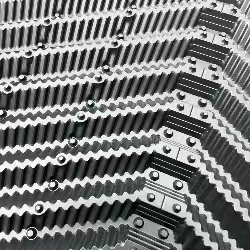
Why More Cooling Tower Fill Does Not Always Mean More CoolingWhen a cooling tower needs more cooling
Contact our team for cooling tower fill media details, quotations, and project support.
Chat on WhatsApp