
In modern industrial cooling systems, co
How to Calculate Cooling Tower Fill Volu
When the Original Cooling Tower Fill Is
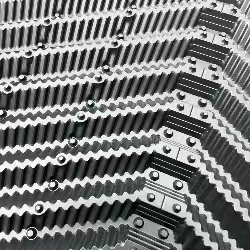
When a cooling tower needs more cooling capacity, one idea often appears first: increase the amount of Cooling Tower Fill.
It sounds reasonable. More fill means more contact surface, so more fill should mean more cooling. But this assumption ignores an important part of cooling tower engineering: the fill has to work within the available air and water flow conditions.
Adding more fill increases the available contact area only when water and air can still move effectively through that additional volume.
If the existing tower has sufficient water flow but limited airflow, simply increasing the fill depth can increase resistance without producing a proportional improvement in heat transfer.
The same issue can occur when the water distribution system cannot wet the additional fill evenly. In that situation, part of the added fill may contribute much less than expected.
Every structured fill creates some resistance to airflow. The actual resistance depends on the fill geometry, air velocity, fill depth, and operating conditions.
This is why a higher fill section should not be evaluated only by its theoretical surface area.
If the additional fill increases pressure drop beyond what the fan system can effectively handle, the tower may lose airflow. The result can be the opposite of what the retrofit was intended to achieve.
In a cross-flow cooling tower, air travels horizontally through the fill while water moves downward. Therefore, increasing the fill section changes the path through which air must travel.
A product such as 1470mm Width Cooling Tower Fill or 1830mm Width Cooling Tower Fill should therefore be evaluated according to the actual tower arrangement rather than simply asking which product provides more material.
The important engineering question is whether the available airflow can effectively pass through the complete fill section.
Increasing fill volume without checking water loading can also create an imbalance.
The fill needs enough water to develop the intended wetted surface, while excessive or poorly distributed water can change the local operating conditions inside the fill.
For this reason, fill selection should be considered together with water distribution rather than as an isolated component decision. Research on cooling tower performance has shown that uniform air and water distribution throughout the fill is important to achieving the expected thermal performance.
Increasing the fill section can be useful when the original tower has unused capacity in its water distribution, airflow, support structure, and available installation volume.
But those conditions need to be confirmed first.
A properly engineered increase in fill volume can provide additional effective heat-transfer area. An arbitrary increase can instead create higher resistance, uneven water distribution, or installation problems.
Instead of asking, “How much more fill can we install?”, engineers should ask:
That is the difference between simply adding fill and actually improving a cooling tower.
For cooling tower modifications, the objective should not be maximum fill volume. It should be the best balance between effective heat transfer, airflow, water distribution, and the physical limitations of the existing tower.
Cooling tower fill media updates and technical insights for global industrial clients.
In modern industrial cooling systems, cooling tower fill plays a critical role in improving heat exc
Why More Cooling Tower Fill Does Not Always Mean More CoolingWhen a cooling tower needs more cooling
Contact our team for cooling tower fill media details, quotations, and project support.
Chat on WhatsApp