
How to Calculate Cooling Tower Fill Volu
In modern industrial cooling systems, co
When the Original Cooling Tower Fill Is
When a cooling tower struggles to meet its required outlet water temperature, adding more fill can sound like a reasonable solution.
More packing means more potential contact area between water and air.
But there is a limit to how useful that additional area can be.
If the tower cannot maintain sufficient airflow through the deeper fill section, the expected improvement may not appear.
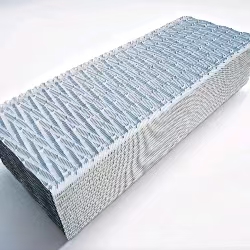
Honeycomb cooling tower media creates structured passages for water and air.
These passages provide the contact conditions needed for evaporative cooling.
However, air experiences resistance as it moves through the fill.
Increasing the depth of the media can increase the total resistance of the airflow path.
If the fan cannot maintain the required airflow, adding more fill may provide less benefit than expected.
A cooling tower fan operates against the resistance of the complete air path.
That includes the air inlet, fill, drift eliminators, and other internal components.
Changing the fill arrangement can alter the system resistance.
The fan's actual operating point may then change.
Before increasing fill depth, I would review the fan performance information and the expected resistance of the proposed media.
Without those details, it is difficult to predict whether the modification will improve cooling performance.
Two fill products with similar external dimensions may have different internal channel geometries.
The corrugation pitch, sheet arrangement, and passage structure can influence airflow resistance.
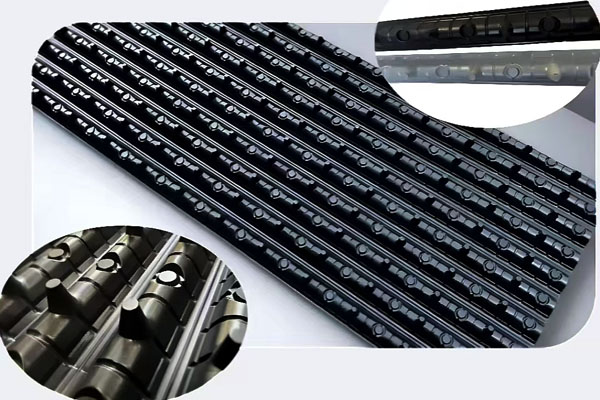
For example, 18mm pitch corrugated fill with multiple width options provides one geometry to consider when evaluating a proposed media arrangement.
However, the pitch alone does not establish the pressure drop of the complete fill pack.
Reliable comparison requires performance information for the relevant operating conditions.
In an existing cooling tower, the available space is usually fixed.
Increasing fill depth may reduce clearance around other internal components or require changes to the support arrangement.
It can also complicate maintenance access.
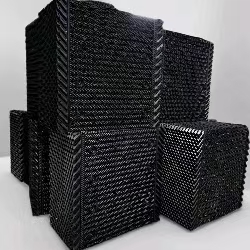
For towers with wide installation sections, wide-format film fill for flexible cooling tower media configurations may be useful when reviewing dimensional options.
The final arrangement still needs to preserve the required airflow path and maintenance clearance.
Sometimes the more useful question is whether the existing media geometry is appropriate for the tower's operating conditions.
If the original fill has become heavily fouled, restoring the intended airflow passages may be more effective than increasing the fill volume.
If the existing structure is unsuitable for the water quality, a different media arrangement may deserve consideration.
For applications with persistent fouling, splash grid fill for fouling-prone cooling towers provides an alternative structure to evaluate.
That does not mean splash fill is automatically interchangeable with honeycomb film fill.
The thermal requirements, available space, and support system must be checked before making such a change.
I would begin with the tower's current operating data.
That includes circulating water flow, entering and leaving water temperatures, ambient wet-bulb temperature, and available airflow.
Next, I would inspect the existing fill for deposits, deformation, and blocked passages.
Only after confirming the current operating condition would I evaluate whether additional media depth is justified.
Don't increase cooling tower packing depth simply because the tower is struggling to meet its temperature target.
First determine whether the limitation comes from insufficient heat transfer area, restricted airflow, poor water distribution, or operating conditions beyond the original design.
If additional fill is being considered, the proposed geometry and pressure drop should be reviewed together with the fan performance.
A suitable honeycomb fill arrangement is one that works with the tower's available airflow, not simply the one that occupies the most space.
Cooling tower fill media updates and technical insights for global industrial clients.
In modern industrial cooling systems, cooling tower fill plays a critical role in improving heat exc

Cooling Tower Packing Depth: Why Adding More Honeycomb Fill Can Make Airflow the Limiting FactorWhen
Contact our team for cooling tower fill media details, quotations, and project support.
Chat on WhatsApp